International Transitions
A multidisciplinary journal on institutional, economic, and organizational change
International Transitions is a peer-reviewed multidisciplinary journal on major transformations affecting societies, organizations, institutions, and economies — bridging economics, management, law, and sociology.
A Plurality of Ecological Futures
Across academic, political and organizational arenas, the ecological transition is increasingly framed as a technical challenge requiring innovation, efficiency and new business models. Yet the contributions assembled in this issue remind us that ecological transformation is never purely technical: it is simultaneously cultural, emotional, political, and imaginative. Together, they illuminate the multiple ways in which environmental futures are envisioned, contested and embodied — whether through individual emotions, collective knowledge, pedagogical tools or geopolitical narratives.
The first contribution mobilizes The Mosquito Coast as a pedagogical device to invite students to question the seductive promise of green entrepreneurship. Through the lenses of dark ecology and eco-fascism, it reveals how utopian ecological ideals can slide into authoritarian or destructive logics when they ignore the complexities of human–nature entanglements. This article foregrounds the importance of cultivating critical ecological literacy, challenging simplistic narratives that equate sustainability with technocratic problem-solving.
The second contribution, derived from the WCEF Accelerator Session “Ancestral Knowledge and the Circular Economy,” shifts the focus from critique to alternative pathways of knowledge and practice. By highlighting Indigenous-led initiatives, foresight methodologies and intergenerational wisdom, it demonstrates how ancestral knowledge systems can enrich or even reorient circular economy approaches. Here, ecological transformation emerges not as a purely modern project but as a space where traditional, scientific and futures-oriented knowledges intersect, opening avenues for more inclusive and culturally grounded transitions.
A third article re-centres the discussion on the role of eco-emotions in shaping individual engagement. Drawing on recent surveys and behavioural research, it proposes the concept of eco-conscience to articulate the intertwined layers of emotions, environmental knowledge and behavioural responses. By identifying eight eco-consciousness profiles and their associated risks and opportunities, the article offers an operational framework for practitioners and institutions seeking to support individuals in navigating cognitive shocks, emotional overload and pathways to action. Ecological transition here is not only a matter of information or policy but also of psychological landscapes and affective trajectories.
The final contribution adopts a geopolitical and critical perspective on the circular economy. Through an interpretive case study of lithium extraction in Bolivia, it argues that dominant circular economy discourses risk perpetuating extractivist and colonial dependencies under the guise of ecological modernization. This analysis highlights how, without explicitly decolonial and community-centred approaches, circularity can become another form of green branding that masks structural asymmetries between the Global North and South. It thus brings into relief the political tensions that underpin global sustainability narratives.
Taken together, these four contributions offer a multi-layered understanding of ecological transformation: the imaginative, through cinema and ecological thought; the cultural, through Indigenous knowledge and futurity; the individual and emotional, through eco-consciousness; and the geopolitical, through critical analyses of circular economy narratives. Their dialogue reveals a shared concern: ecological transition cannot be reduced to a set of technical fixes. It demands a rethinking of how societies feel, imagine, govern and narrate their relationship with the Earth.
Teaching Peace, Facing Resistance, Shaping Transitions
This fourth issue of International Transitions opens with a strong and timely plea by Piotr Jednaszewski, Director of the St. Mary’s Institute in Ireland and PhD in Education, advocating for the integration of peace education into school and university curricula. In a world witnessing a troubling surge in armed conflicts — with their number having doubled over the past five years according to ACLED (Armed Conflict Location & Event Data) — this proposal resonates with particular urgency. Today, fifty countries are affected, and one in eight people worldwide has been directly or indirectly exposed to war, amounting to 12.5% of the global population. While Western Europe had long remained relatively untouched, recent conflicts in Georgia, the Balkans, and more recently Ukraine remind us that peace is fragile. In such a context, education can no longer remain neutral. It must become a lever for awareness, prevention, and action.
Extending this reflection on transformative dynamics, this issue examines one of the fundamental tensions at the heart of any transition: resistance to change. Widely documented in sociology, psychology, and management sciences, this resistance takes many forms. It may be rational, reflecting a desire to safeguard existing assets, or irrational, driven by fear, cognitive biases, or deep-seated emotions. Whether individual or collective, resistance is a central phenomenon for understanding contemporary social, technological, and organizational transformations.
The Challenges of Defining an Ethics for Transitions
The third issue of International Transitions delves into the ethical dimensions of international transformations, focusing on one of the central aspects of transitions as defined by Pascal Chabot in L’âge des transitions. According to Chabot, transitions, while often gradual, are also desired changes. This raises an important question: What do we desire? This question takes us directly to the notion of ethics.
Ethics, a fundamental concept, guides our actions and choices, shaping the way we live and interact with the world. It holds a prominent place in research, particularly in the field of business. As early as the 1980s, the establishment of the Journal of Business Ethics reflected the growing importance of this theme. Its founder, Alex Michalos, offered a broad definition of ethics: “Ethics is broadly interpreted to include any human action aimed at ensuring a good life.” But how do we define a good life? According to Michalos, “an action is ethically required if, in the long term and overall, it seems to increase the chances of producing the best kind of life for the greatest number of people.”
At the heart of ethics lies a reflection on what is just, good, and responsible. This discipline encourages us to question our values, principles, and behaviors, and to align them with what we consider to be the common good. In the context of transitions, ethical reflection takes on even greater importance. Transitions represent major shifts in our societies and ways of life, often driven by complex challenges such as climate change, social inequalities, or technological revolutions. These changes inevitably raise fundamental ethical questions: How should we respond to these transformations? What are our responsibilities towards future generations? How can we ensure equity and justice throughout these transition processes?
Raising these ethical questions is essential for several reasons. First, it allows us to become aware of the repercussions of our actions and decisions and to critically assess them. Second, it helps clarify the values and principles that should guide our choices during periods of transition. Finally, it fosters an inclusive and participatory dialogue on the ethical issues surrounding transitions, engaging all stakeholders in the search for fair and sustainable solutions.
CLIFI and Voluntary Career Transitions
It is with pleasure that we open this second issue of the International Transitions Journal by welcoming a new partner, the ASAP observatory, dedicated to the study and analysis of the impacts of social and societal transformations on public actions, led by Professor Olivier Meier. This partnership will undoubtedly enrich the contributions to understanding transitions published in our journal.
In this issue, Olivier Meier presents the observatory as well as his vision of the mutual benefits enabled by this new partnership, which illustrates the dynamism of research on transitions.
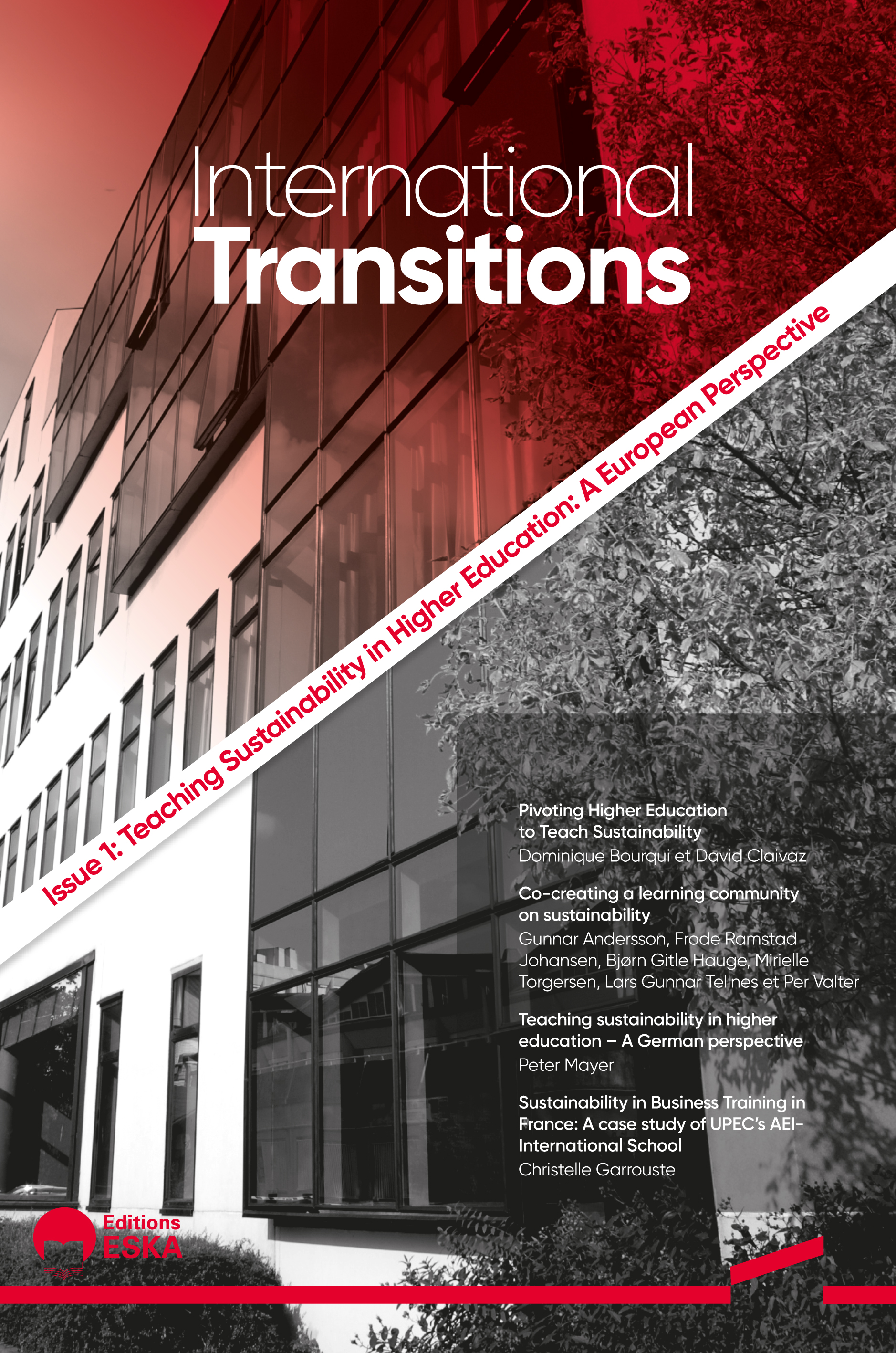
Teaching Sustainability in Higher Education: A European Perspective
Transition is defined as moving from one state to another, usually slowly and gradually. When interviewed by journalists, students at our universities often define themselves as the “transition generation”. This statement is consistent with a definition from Pascal Chabot’s book, L’Âge des Transitions, in which transition is defined as “desired change”.
However, when we look at the issue of transition, whether environmental, digital or societal, the outlook is bleak. In 2021, more than three-quarters of the world’s energy sources — and on a global scale, the main source of electricity generation — is still coal. More than 8,000 tons of coal were consumed in 2022. These figures lead some to say that the transition, especially in energy, never took place, but that elements were added to meet new needs without the previous ones disappearing.
On the societal level, studies reveal that in the space of ten years, between 2011 and 2021, the proportion of the world’s population living under autocratic regimes rose from 5% to 36%, which means 2.8 billion people. In 2021, there were five military coups and one regime overthrow. These developments raise questions, because at the same time, calls for a renewal of democracy and respect for freedoms and human rights have never been so numerous or so loud.
These examples illustrate the discrepancies between the reality of the notion of transition and the aspirations it covers. These discrepancies call into question and make it necessary to conduct research and develop new training programs in order to meet the expectations of new generations.
Submit an Article
Manuscript submissions are managed through the journal's online platform. Please consult the submission guidelines for instructions on manuscript preparation and the review process.
Submit a manuscriptEditorial Board
Editors-in-Chief
- Alexandra d'Anglemont de Tassigny — Associate Professor in Fundamental and Clinical Biological Sciences; Director of EPISEN, Université Paris-Est Créteil
- Philippe Frouté — Professor in Economics; Researcher at LIPHA Paris-Est; Director of AEI International School, Université Paris-Est Créteil
Managing Editor
- Helen Mundler — Associate Professor (HDR), Université Paris-Est Créteil; Lecturer at AEI International School; Researcher at LERMA (UR 853)
Scientific Committee
- Akrout Wafa · Management Sciences · AEI International School, UPEC, France
- Andersson Gunnar · Economics · Østfold University College, Norway
- Bagayev Igor · Economics · AEI International School, UPEC, France
- Berthon Boris · Management Sciences · AEI International School, UPEC, France
- Bourqui Dominique · Director of the Doctoral School · Business School of Lausanne, Switzerland
- Chou Te-Kuang · Finance · Southern Taiwan University of Science and Technology, Taiwan
- Ciabrini Sylvie · Public Law (HDR) · AEI International School, UPEC, France
- Claivaz David · Dean · Business School of Lausanne, Switzerland
- Desban Marc · Management Sciences · AEI International School, UPEC, France
- Du Marais Bertrand · State Councillor; Associate Professor · AEI International School, UPEC, France
- Figueroa Diaz Ferrière Tamara · Iberian Studies · AEI International School, UPEC, France
- Fu Lan · Chinese Studies · AEI International School, UPEC, France
- Garrouste Christelle · Economics · AEI International School, UPEC, France
- Grima François · Management Sciences · AEI International School, UPEC, France
- Henderson-Peal Marcella · Vice-Dean · AEI International School, UPEC, France
- Koch Felipe · Sociology · AEI International School, UPEC, France
- Mayer Peter · Economics · University of Applied Sciences Osnabrück, Germany
- Mehtiyeva Kamalia · Private Law and Criminal Sciences · AEI International School, UPEC, France
- Musile Tanzi Paola · Finance · University of Perugia; SDA Bocconi School of Management, Italy
- Schneid Frederick · History · United States Military Academy, West Point, USA
- Tschech Christina · Art History · AEI International School, UPEC, France
- Valdès-Zamora Armando · Hispanic and Latin American Studies · AEI International School, UPEC, France
- Vasselin Françoise · Economics · AEI International School, UPEC, France
- Vuong Cuong H. · Economics · AEI International School, UPEC, France